
3Rs: Regulate - Relate - Reason
Bruce Perry likes to have easy ways to remember some of his concepts and I really like this one.
Have you ever had a time where you were trying to talk some sense into someone and it was going nowhere? It may have been because there were not in a space to hear your (I am sure very valid) argument.
Based on his concept of state-dependent functioning, Bruce Perry uses the mnemonic of the 3 Rs to remind us that before using reason or for us to listen to someone, we need to feel like the other person gets us and even before that, we need to feel like we want to be around that person.
This is where the 3Rs come into place:
1. Regulate: If people are not regulated, they will most likely be in a headspace of “leave me alone”. So think about the different ways one can regulate to get to this space.
2. Relate: This is the time for connection (Dan Siegel and Tina Payne-Bryson call this “connection before correction”). My advice here is validate, validate, validate. “I can see you are upset. It makes so much sense you would be.”
It is also a time for repair, talking accountability and ownership for mistakes and making amends. Sometimes, it can also look like a gesture, or a hug, depending on whether you like gestures or touches.
3. Reason: Now that people feel like they want to be with someone else and are ready to listen, people can have productive conversations.
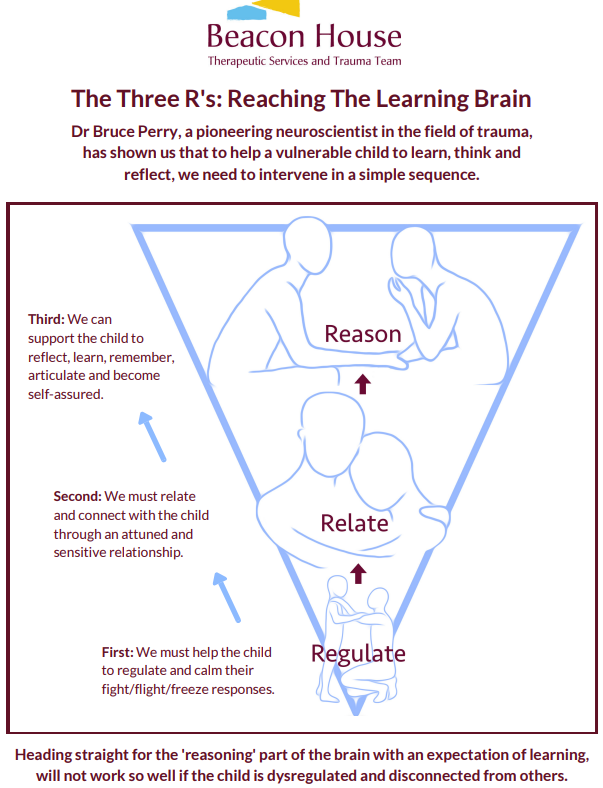
A visual of the 3Rs by Beacon House. You can access their pdf by clicking here.
What it means in practice
In practice, this means that if you are dealing with a person who appears dysregulated, talking to them will not work and may make things worse.
For parents with children whose nervous system is more vulnerable to stress, it means that more often than not, talking will not work and the aim of the game should be to focus on regulation and connection.
However, the 3Rs are also important for ourselves. Before we can think clearly, we also need the 3Rs for ourselves.
Finally, you may also come across a 4th R, which is not part of Bruce Perry’s concept, but has been added by Louise Michelle Bombèr and her Relational Practice: Restore / Repair. While Bruce Perry may have it within the second step of his concept, it may indeed make more sense to repair and restore once the person can reason and really take in the information that “our relationship is still okay”.
