
Dosing - Small doses of regulation
Bruce Perry’s concept of dosing states that small regular doses of regulations are more effective to keep you within your window of tolerance than large unregular doses. (As a side note, the window of tolerance is a concept that was developed by Dan Siegel and represents a state where one can be calm or very excited about something without losing it and staying connected to others. Here is a video from the Beacon House who also has many other helpful resources on developmental trauma on their website).
This goes along with Bruce Perry’s idea that rhythm promotes regulation of the nervous system.
For instance, taking small breaks throughout your day may help you feel less stressed overall rather than waiting until the end of the day and go to your regulatory activity (walk, exercise, etc.).
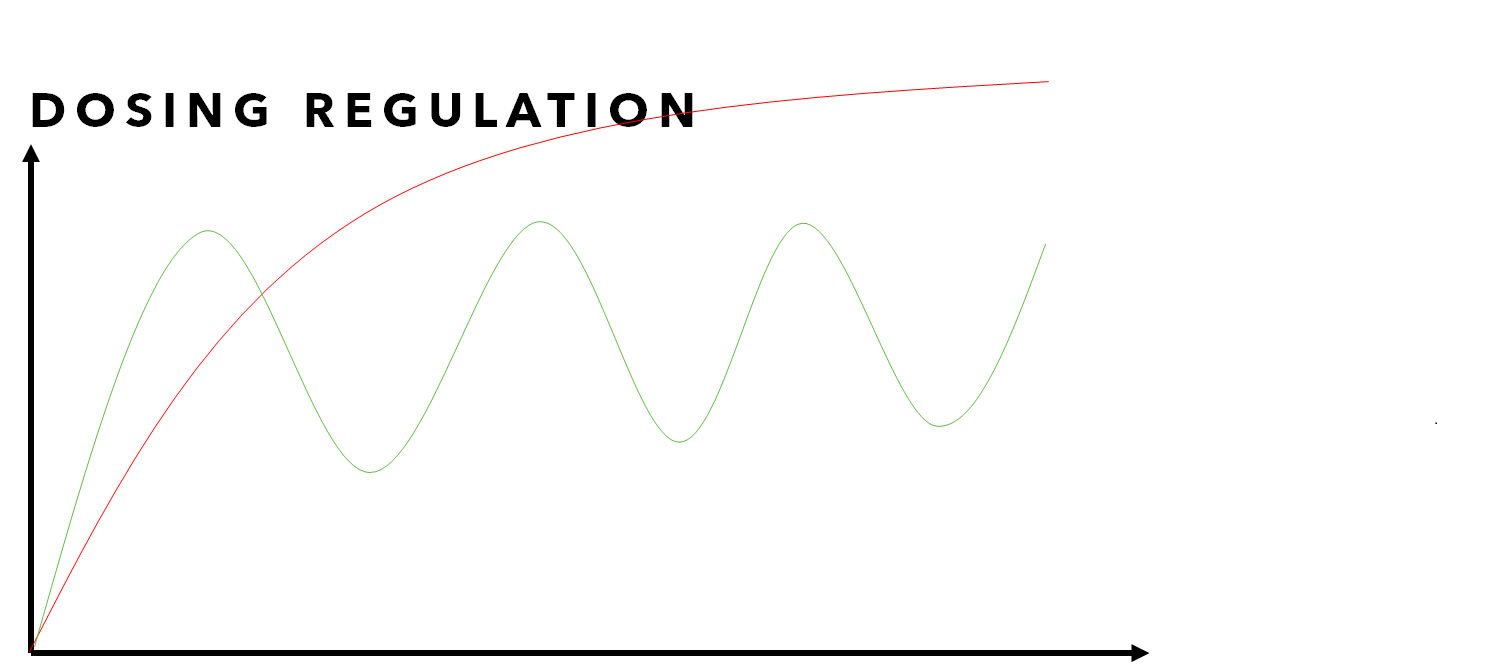
The y-axis (up arrow) is stress from low to high and the x-axis (horizontal arrow) is time. The green oscillating curve displays dosing, while the red curve displays no dosing.
On the graph above, if time is a day, then if one engages in a regulatory activity at the end of the day, then stress will indeed go down, but may not go down as much as it would through dosing. So the next day, you may wake up with a higher level of stress, and the cycle continues.
Why this is clinically helpful
Clinically, I work with many children, young people, and adult, whose nervous system has been sensitized and/or with a narrow window of tolerance.
So, looking at the visual graph above, one can use the x-axis as any amount of time that is useful for them. Let’s say the person is dysregulated at the end of the day (keep in mind Dan Siegel would remind us of HALT (Hungry Angry Lonely Tired), which tends to get us on the edge of our window of tolerance), then the x-axis would be 24 hours. If a person gets dysregulated several times a day, then you will want to think of the x-axis as maybe 6 hours, or less.
I have found in my practice that for people for whom their window of tolerance can expand (this may be more limited for people with neurodivergent differences), staying in their window of tolerance for longer period of time starts expanding the window. Overtime, it is dancing at the edges that will expand it the most, but spending more time regulated will be a good place to start.
The tricky next part is to find regulatory activities. This will probably connect to the article on pathways to regulation, but one will also want to consider:
what energy level do I need to engage in my next activity?
If I need a lot of energy and I am feeling low, I will want an up-regulating activity.
If I need less energy, then I will want more of down-regulating activity.
These will depend on each individual and you will want to try a few out while tracking your energy level / nervous system activation to find out what works for you.
