
Reward Bucket
Bruce Perry has another helpful concept called the Reward Bucket. He explains reward systems in this video and at minute 11 and 50 seconds, you can see a visual.
The basic idea is that we are social animals and thus wired for connections. That means that our reward system in our brain (yes, similar to the one highjacked in additions) is wired to make us feel good when we are connected to others and it motivates us to seek others.
This “feel good” feeling then fills up our reward bucket on a daily basis and our bucket can be filled with other things that can help us feel good (rhythms, food, acting in ways that are aligned to our values, etc.). In the picture below, I forgot to add sex, but this is another activity that people can find rewarding as well.
If the brain has learned (and will then predict) that relationships are not as rewarding, then individuals may need to rely on other aspects to "feel good”, which will include any behaviours or substances that will activate the reward system. They may engage excessively in these activities to compensate.
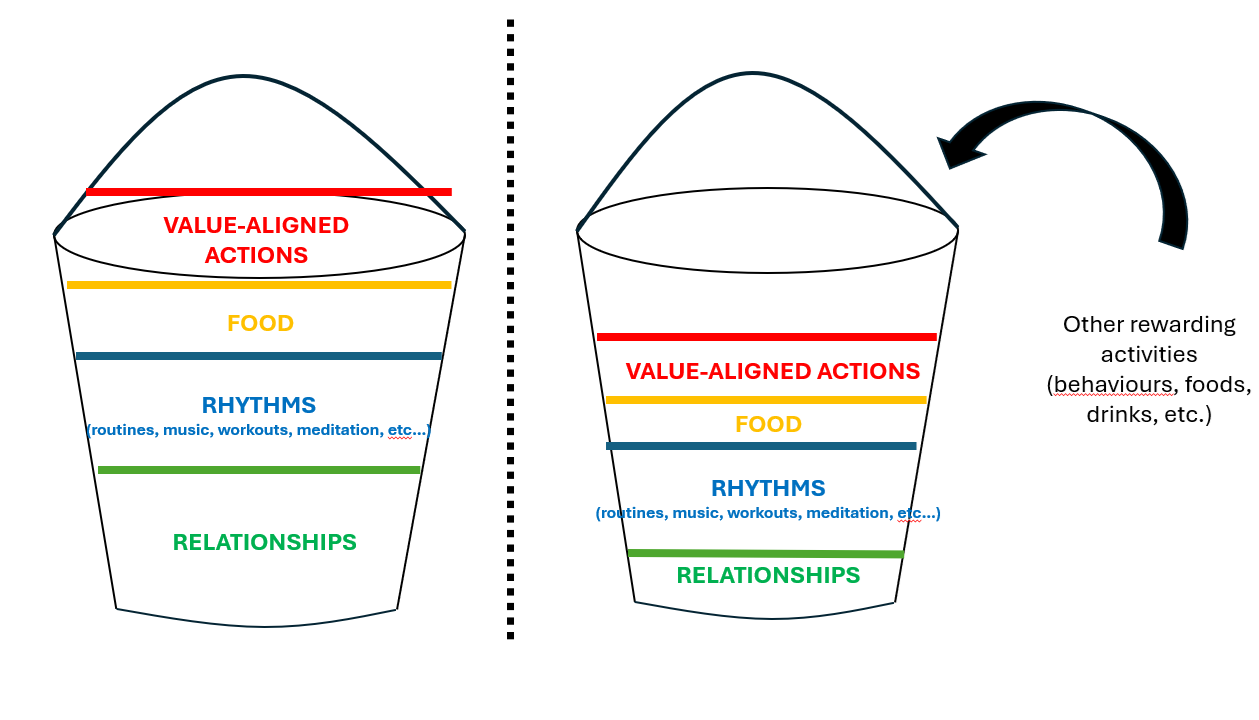
On the left, a reward bucket where the brain has learned and predicts that relationships will be safe and rewarding. On the right, the brain has learned that relationships only brings limited reward. To feel good, other activities will thus be needed.
What does this mean in practice?
This means that when people engage excessively in some rewarding behaviours that may be damaging to their health or functioning, there are several ways we can support them.
Thinking about ways to regulate and exploring with them other ways to regulate may be helpful.
In addition, if they find little rewards in connecting with others, work can be done with them to support their brain start to find relationships more and more rewarding. It will take patience and consistence to convey cues of safety to their brain that may predict threat, but there is hope.
